
Mindset Coaching: 10 Powerful Ways for Lasting Success 2025
Understanding Mindset Coaching: The Key to Open uping Your Potential
Mindset coaching is a specialized form of coaching that helps individuals identify and transform limiting beliefs, negative thought patterns, and mental blocks that prevent them from achieving their goals. Unlike traditional therapy that focuses on healing past trauma, mindset coaching is future-oriented and action-focused, using evidence-based techniques to rewire subconscious programming for lasting change.
Quick Overview of Mindset Coaching:
– What it is: A structured process to shift thinking patterns and beliefs
– How it works: Uses techniques like cognitive reframing, NLP, and visualization
– Who it helps: Anyone feeling stuck, struggling with self-doubt, or seeking breakthrough results
– Key difference: Focuses on changing internal thought patterns rather than external circumstances
– Timeline: Typically 3-6 months for meaningful change
– Result: Improved confidence, clarity, and ability to achieve goals
The foundation of mindset coaching rests on neuroplasticity – the brain’s ability to form new neural pathways throughout life. Research shows that with consistent practice, we can literally rewire our brains to think differently.
Fixed mindset tells us our abilities are set in stone, while growth mindset recognizes that skills and intelligence can be developed through effort and learning. Mindset coaches help clients shift from limiting fixed beliefs to empowering growth-oriented thinking patterns.
As Coach Mary Chege-Kamau, a PCC Professional Certified Coach by the International Coaching Federation with expertise in personal and executive coaching, I’ve helped thousands of professionals overcome limiting beliefs through targeted mindset coaching interventions.
Easy mindset coaching glossary:
– mindset coach vs life coach
– positive thinking life coach
What Is Mindset Coaching?
Mindset coaching is a specialized approach that helps you identify and transform the limiting beliefs, negative thought patterns, and mental blocks that act like invisible barriers between you and your goals. It’s not about surface-level motivation – it’s about getting to the root of why you might feel stuck.
The field has its roots in cognitive psychology, particularly Carol Dweck’s research on fixed versus growth mindsets. Her work revealed that people with a fixed mindset believe their abilities are carved in stone, while those with a growth mindset see challenges as opportunities to develop new skills.
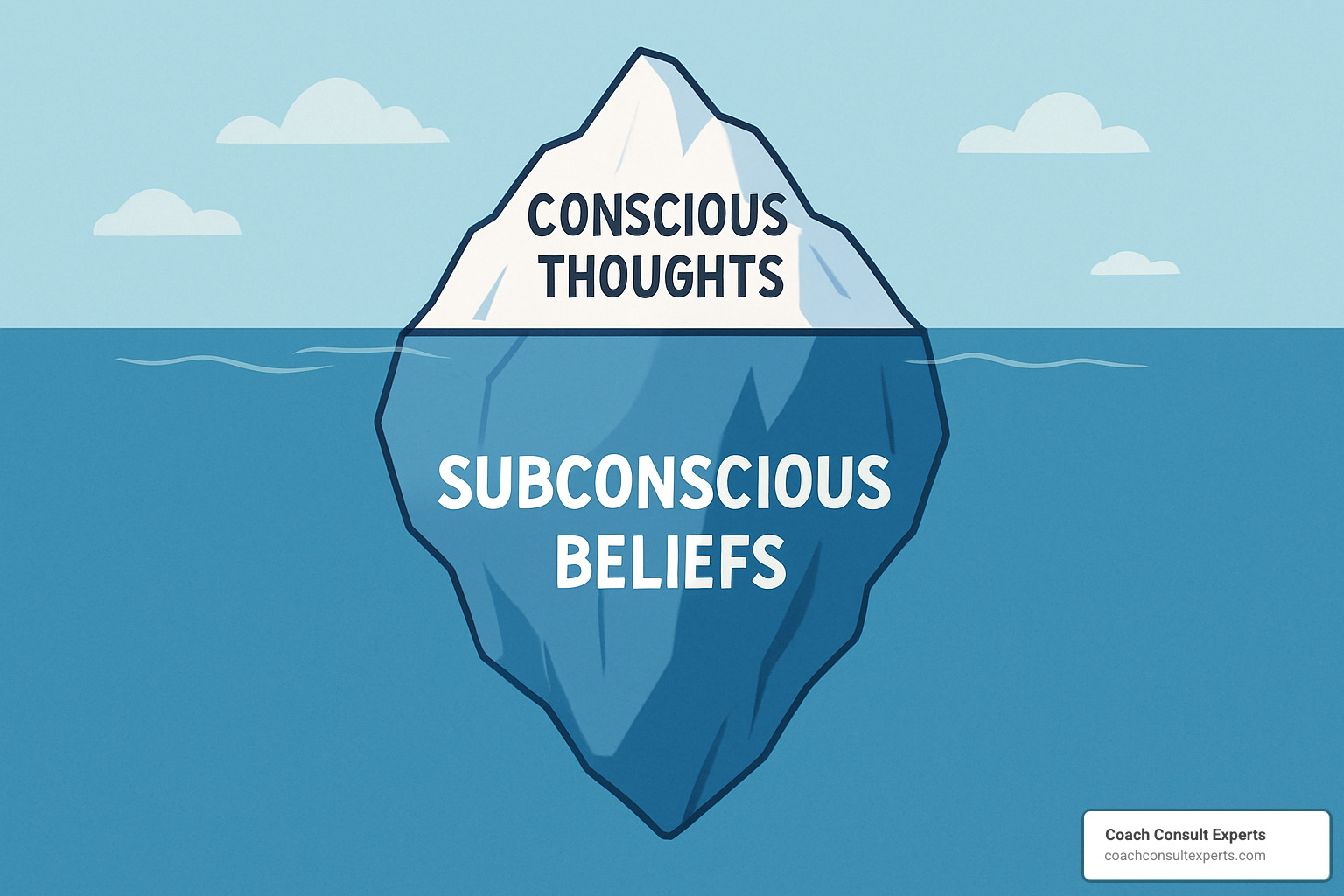
Modern neuroscience shows us that our brains are constantly changing through neuroplasticity – the ability to form new neural connections throughout our lives. Your brain produces up to 50,000 thoughts daily, and about 95% of them are the same thoughts you had yesterday. Mindset coaching works with your subconscious programming – those automatic thought patterns that run in the background.
Scientific research on cognitive-behavioral change demonstrates that with consistent practice and the right techniques, you can literally rewire your brain to think differently.
| Aspect | Mindset Coach | Life Coach |
|---|---|---|
| Primary Focus | Internal thought patterns and beliefs | Broad life goals and external achievements |
| Approach | Subconscious reprogramming | Action planning and accountability |
| Techniques | NLP, CBT, hypnosis, EFT | Goal setting, strategic planning |
| Timeline | Deep change (3-6 months) | Varies by goal complexity |
| Root Cause | Addresses underlying beliefs | May focus on symptoms |
Mindset Coaching vs Therapy
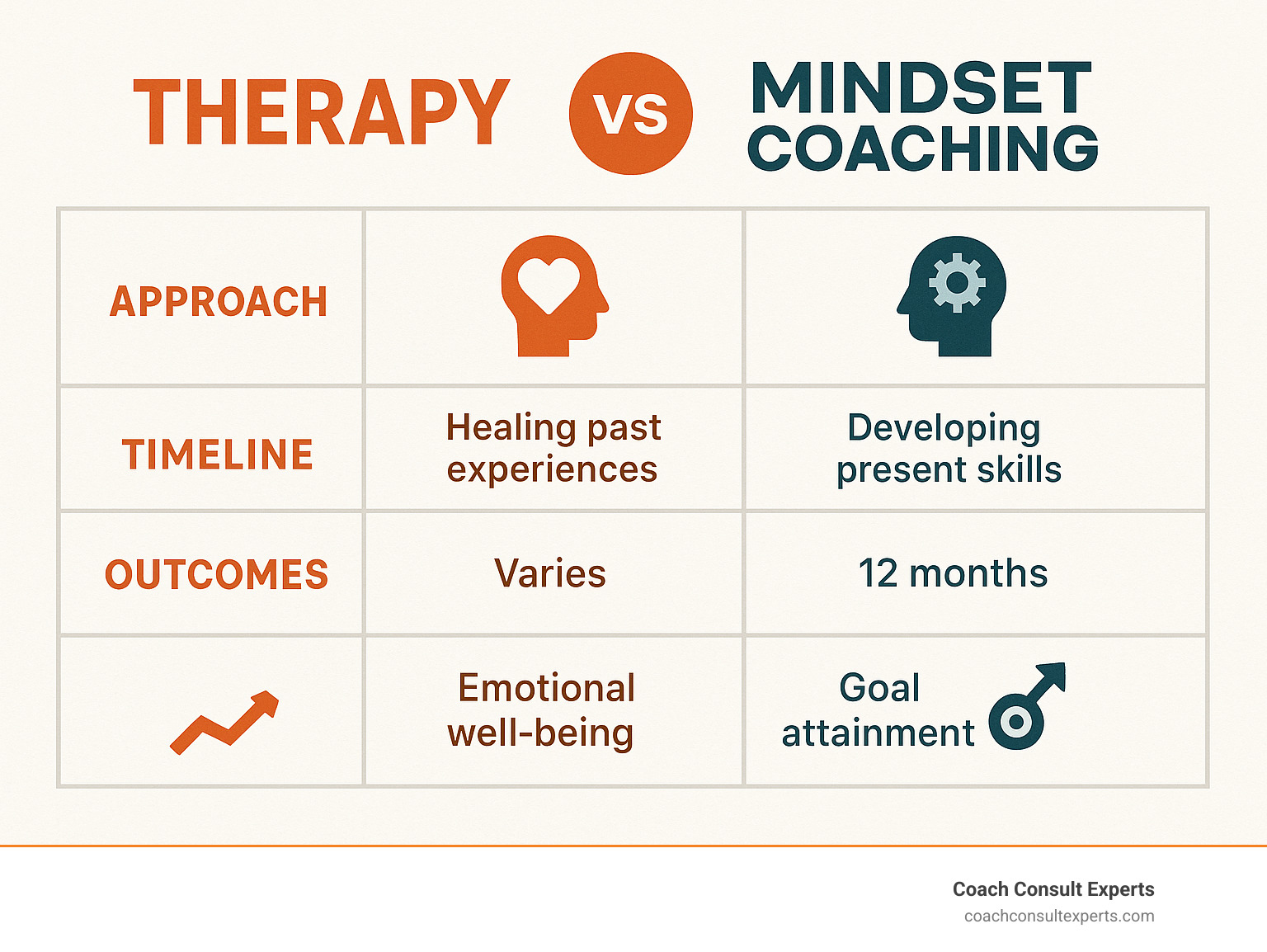
Therapy typically focuses on healing past wounds and understanding why certain patterns developed. Mindset coaching, on the other hand, is more like being an architect for your future. We’re less concerned with why your old mental blueprint was created and more focused on designing a new one that serves your current goals.
While therapy might ask “Why do you have this fear?” mindset coaching asks “How can we transform this fear into confidence?” We work with what’s present now and use specific techniques to shift it rapidly.
Mindset Coaching vs Executive & Life Coaching
Executive coaching typically focuses on leadership development and professional performance. Life coaching takes a broader approach, covering everything from career transitions to relationship goals.
Mindset coaching is more specialized – we focus specifically on your internal landscape. More info about Mindset Coach vs Life Coach explains how we use neuroscience-based techniques to create rapid subconscious shifts.
We work with techniques like hypnosis, Timeline Therapy, and EFT to access and change the subconscious programming that runs about 95% of your daily experience.
Common Mindset Blocks & Limiting Beliefs
Certain mental patterns show up repeatedly, operating like invisible barriers that create self-sabotage even when someone consciously wants to succeed.
Imposter syndrome affects up to 70% of people at some point in their careers. These clients often downplay their successes and hesitate to pursue opportunities they’re perfectly qualified for.
Self-doubt manifests as that persistent inner critic questioning every decision. The scarcity mindset creates the belief that there’s not enough to go around – not enough money, opportunities, or success. More info about Scarcity Mindset Coaching explores how mindset coaching helps clients shift from scarcity to abundance thinking.
Perfectionism disguises itself as having high standards, but it’s actually a creativity killer. Fear of failure keeps people playing small, while negative self-talk creates constant self-criticism.
Identifying Your Own Blocks
Self-awareness is the first step toward freedom from these mental patterns. Journaling exercises help identify recurring thoughts and emotional triggers. Thought audits involve examining the actual evidence for and against your limiting beliefs.
Here are 5 powerful self-reflection questions:
- What thoughts or stories am I telling myself about this situation?
- What would I do if I knew I couldn’t fail?
- What beliefs did I inherit from my family or culture about success?
- When do I feel most confident and capable?
- What would someone who loves me unconditionally say about my capabilities?
Reframing & Growth-Mindset Techniques
Cognitive reframing involves consciously choosing new perspectives that serve your goals. Possibility thinking uses “What if?” questions to crack open new options.
Visualization leverages neuroplasticity – your brain can’t tell the difference between a vividly imagined experience and a real one. Scientific research on visualization power shows that mental rehearsal activates the same neural pathways as actual performance.
Affirmations work when they’re believable and specific. Mindfulness practices create space between thoughts and reactions, allowing you to observe your mental patterns without being controlled by them.
The Mindset Coaching Process & Tools
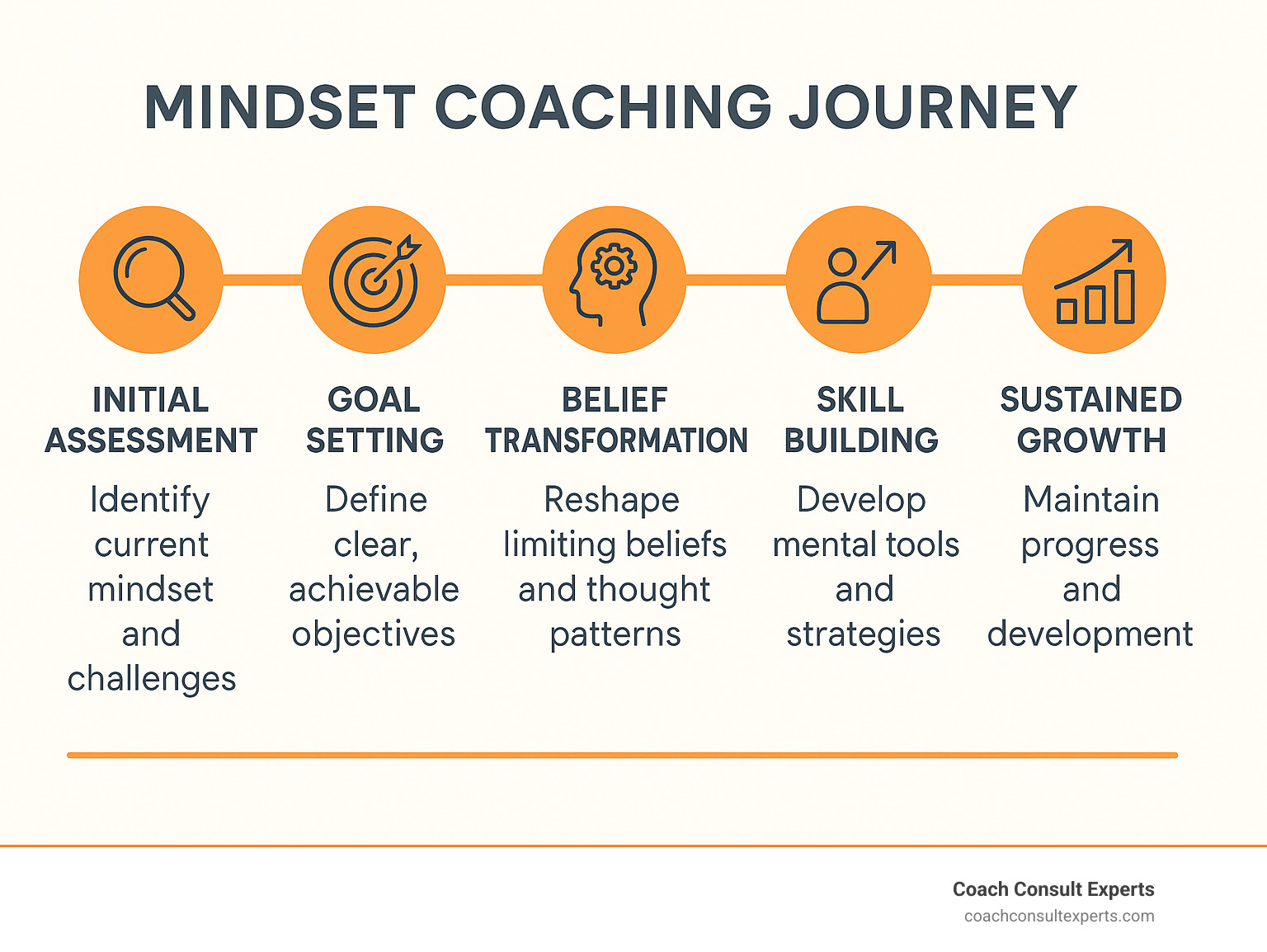
Real change happens through a thoughtful, structured process. The journey begins with a comprehensive intake interview where we explore your goals and the invisible barriers holding you back.
Goal setting goes deeper than writing down what you want to achieve. We identify who you need to become to achieve them naturally. When your identity aligns with your goals, success becomes inevitable.
We use powerful questioning that opens up your own wisdom. Questions like “What would need to be true for you to feel completely confident in this situation?” create those “aha!” moments that shift everything.
Our toolkit includes proven techniques: Neuro-Linguistic Programming (NLP) helps rewire mental programs. Emotional Freedom Technique (EFT) combines cognitive therapy with gentle acupressure to release emotional blocks. Cognitive Behavioral Therapy (CBT) principles show the connection between thoughts, feelings, and behaviors.
Timeline Therapy works with how your unconscious mind stores memories. Hypnosis allows us to communicate directly with your subconscious mind, bypassing resistance to change.
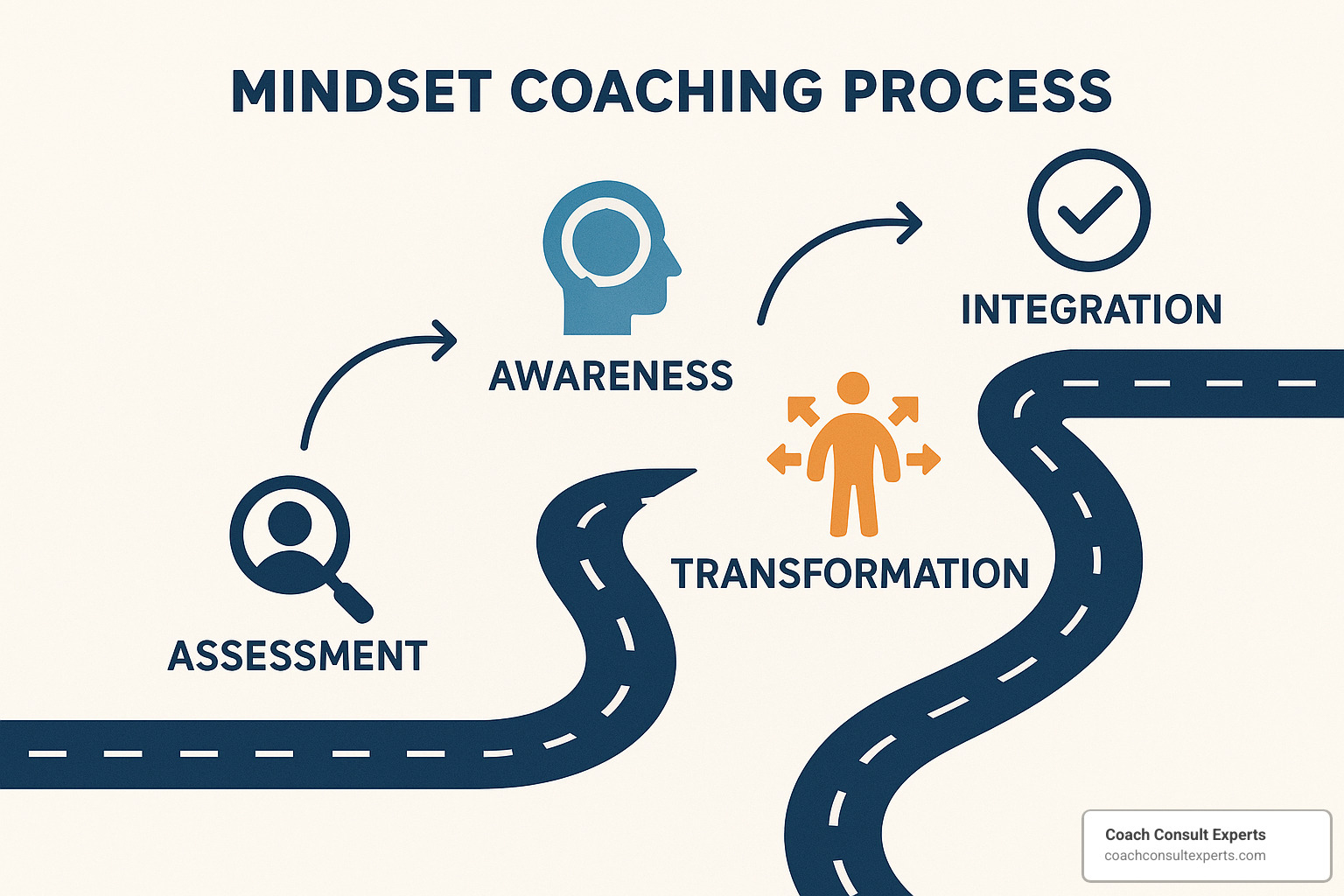
More info about Subconscious Change explains how we facilitate rapid change by working directly with the unconscious mind.
Sample Session Flow
We start with a check-in about what’s happening in your world. Next comes the belief audit, where we dig into specific thoughts and patterns. The guided exercise is where real magic happens – using techniques like visualization or EFT to dissolve limiting beliefs.
We create a clear action plan that bridges your new mindset with concrete steps, and set up accountability structures between sessions.
Popular Coaching Frameworks
NLP (Neuro-Linguistic Programming) excels at rapid belief change. Neuro-Linguistic Programming primer explains how NLP works by changing internal representations that drive behavior.
EFT (Emotional Freedom Technique) is effective for releasing emotional blocks. Emotional Freedom Technique resource provides scientific backing for this approach.
Mindfulness-based approaches help you develop awareness of thought patterns, while Positive Psychology focuses on building strengths and resilience.
Becoming a Mindset Coach: Skills, Training & Certification
The coaching industry is booming with over 70,000 coaches worldwide. The life coaching industry alone is worth $1 billion in the United States, and mindset coaching represents one of the fastest-growing specialties.
Earning potential ranges from $40,000 to $100,000 annually, depending on experience and business model. But this isn’t just about money – it’s about creating profound change while building a fulfilling career.
Empathy and active listening form the foundation. Powerful questioning mastery separates good coaches from great ones. Your communication skills need to be rock-solid for reframing perspectives and guiding emotional breakthroughs.
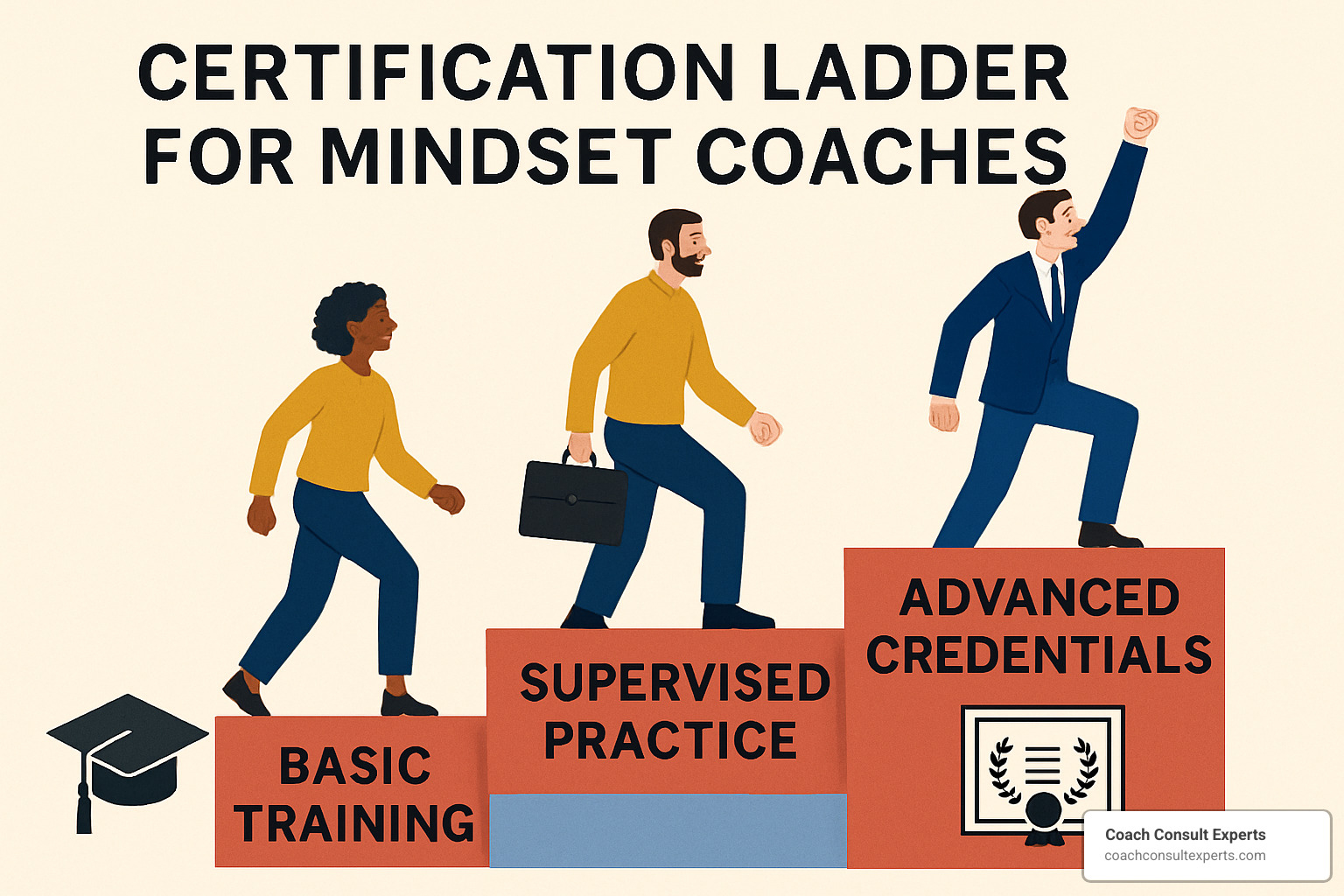
ICF (International Coach Federation) pathways offer the gold standard. The ACC (Associate Certified Coach) requires 60 hours of training plus 100 hours of coaching experience. The PCC (Professional Certified Coach) requires 125 hours of training and 500 hours of experience.
Look for programs that include supervised coaching practice and combine multiple modalities like NLP, EFT, and CBT. Business development training is crucial too.
Setting up your business involves choosing your legal structure. The IRS guide to business structures breaks down tax implications. Niche selection can make or break your success.
Steps to Launch Your Practice
Complete comprehensive training first – aim for at least 60 hours. Log supervised coaching hours toward that 100-hour mark. Develop your unique niche early – the more specific, the easier marketing becomes.
Create your brand identity and set up business systems for scheduling and payments. Build marketing funnels and network genuinely within coaching communities. Offer findy sessions and collect testimonials from every client.
Most importantly, continuously invest in your own development.
Choosing the Right Coach as a Client
Rapport and connection trump everything else. Relevant experience with your specific challenges increases success dramatically. Look for clear methodology and findy calls that feel valuable in themselves.
Testimonials and results from previous clients tell the real story. Look for specific outcomes rather than vague praise.
More info about Mindset Life Coach can help you understand what to expect from the coaching relationship.
Frequently Asked Questions About Mindset Coaching
How long does a typical program last?
Most clients work with us for 3-6 months to create meaningful, lasting change. Three months minimum allows us to identify core limiting beliefs and begin seeing behavioral changes. Six months gives space for comprehensive mindset change and integration. The real key isn’t duration – it’s your level of engagement.
How do I measure progress?
Behavioral changes often appear first – speaking up in meetings or applying for opportunities you would have avoided before. Emotional shifts follow – anxiety transforms into excitement, criticism stops hitting as hard.
Thought pattern awareness becomes automatic. You’ll catch that inner critic earlier and question its validity. Real-life results provide concrete evidence – promotions, new businesses, improved relationships happen naturally as internal blocks dissolve.
Is mindset coaching right if I already see a therapist?
Often yes! Mindset coaching and therapy work beautifully together. Think of therapy as looking in the rearview mirror to heal past experiences, while mindset coaching looks through the windshield toward where you want to go.
Many successful clients work with both simultaneously. Therapy provides emotional processing and healing, while mindset coaching builds empowerment and goal-achievement skills.
We maintain clear boundaries and refer to mental health professionals when deeper therapeutic issues arise. Communication between your therapist and coach ensures comprehensive, supportive care.
Conclusion
Mindset coaching opens doors to lasting change by tackling the real culprit behind limitations – those thought patterns and beliefs that run the show behind the scenes. While quick fixes might give temporary boosts, this deep work rewires your mental programming for change that sticks.
The payoff includes incredible confidence, crystal-clear purpose, breakthrough performance, and deep fulfillment from living authentically. Neuroplasticity means those limiting patterns aren’t permanent – they’re just well-worn paths that can be redirected.
At Coach Consult Experts, we’ve mastered rapid subconscious change through our blend of individual attention and group coaching magic. There’s something special about working on your mindset alongside others who understand – that community support amplifies your breakthroughs.
Maybe you’re battling that voice saying “Who am I to do this?” Perhaps you know there’s a bigger career waiting but can’t make the leap. Or you simply feel you’re playing smaller than your potential.
Mindset coaching can help you step into the version of yourself that’s been waiting. Your current mindset created your current reality – a new mindset can create an entirely new reality.
The tools exist. The support is available. The science proves it works. The only variable left is your decision to invest in yourself.
More info about Coach Yourself Confident gives you additional resources to start your mindset change today.
The person you’re becoming is already cheering you on. Are you ready to meet them?