Overcoming Limiting Beliefs: 7 Powerful Ways to Conquer Doubt
Why Overcoming Limiting Beliefs Is Your Key to Opening Success
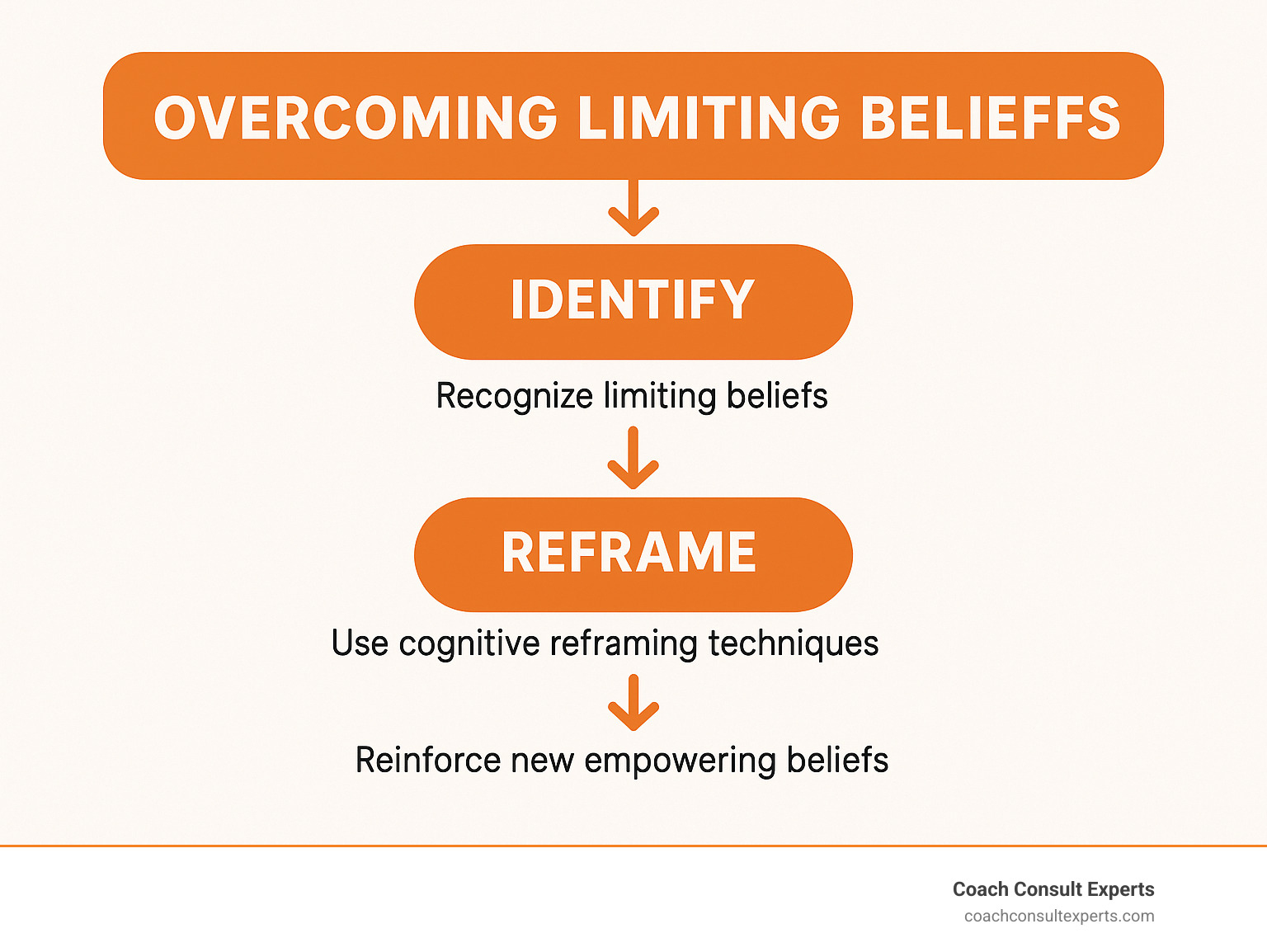
Overcoming limiting beliefs starts with recognizing that the thoughts holding you back aren’t facts – they’re learned patterns that can be changed. Here’s what you need to know:
Quick Steps to Start Overcoming Limiting Beliefs:
1. Identify – Write down recurring negative thoughts about your abilities
2. Challenge – Ask “What evidence supports this belief?”
3. Reframe – Create alternative, empowering statements
4. Test – Take small actions that contradict the old belief
5. Practice – Repeat new thoughts daily until they become automatic
The statistics tell a powerful story: 70% of professionals experience impostor syndrome at some point in their careers, and research shows that many employees lack confidence to share ideas, ask for raises, or engage fully in meetings. These aren’t character flaws – they’re limiting beliefs in action.
Think of limiting beliefs as mental cages with open doors. Like the elephant tied to a post as a baby who never learns it can break free as an adult, we often remain trapped by outdated assumptions about what we can achieve. The good news? Your brain’s neuroplasticity means you can rewire these patterns at any age.
When you’re feeling stuck despite your ambitions, when self-doubt whispers that you’re not qualified enough, or when scarcity thinking keeps you playing small – that’s your limiting beliefs talking. But here’s what the research reveals: these beliefs aren’t permanent. They’re simply neural pathways that got stronger through repetition.
I’m Coach Mary Chege-Kamau, a PCC-certified coach who has helped thousands of professionals break through mental barriers that limit their potential. Through my work overcoming limiting beliefs with clients across generations, I’ve seen how the right techniques can rapidly shift even the most deeply ingrained thought patterns.
What Are Limiting Beliefs & Why They Stick
Limiting beliefs are those sneaky mental stories we tell ourselves that keep us playing small. Think of them as invisible barriers – thoughts like “I’m not smart enough for that promotion” or “People like me don’t start successful businesses.” These aren’t facts about reality; they’re learned assumptions that act like mental prison bars.
What makes these beliefs so powerful is how real they feel. When you’ve been telling yourself “I’m terrible at public speaking” for years, your brain treats that as absolute truth. It’s not lying to you – it’s just working with outdated information.
The fascinating thing about limiting beliefs is they often start with a grain of truth or a single experience. Maybe you stumbled over words in third grade, got rejected from one job, or had someone make a thoughtless comment about your abilities. Your brain, trying to protect you from future pain, turned that moment into a life rule.

The elephant tied to a post perfectly captures how limiting beliefs work. As a baby, the elephant learns it can’t break free from the rope. Even when it grows strong enough to snap that rope easily, it never tries because it “knows” escape is impossible. That’s exactly what happens to us – we stay trapped by beliefs that may have been true once but no longer serve us.
Research on learned helplessness shows how we stop trying when we believe we have no control, even when circumstances change completely. This psychological pattern explains why smart, capable people often hold themselves back from pursuing dreams that are absolutely within reach.
Childhood conditioning plays a huge role in shaping these beliefs. A well-meaning parent saying “Don’t get your hopes up” or a teacher labeling you as “not college material” can echo in your mind for decades. Societal norms add another layer – messages about what’s “realistic” for someone of your background, age, or gender become internalized as personal limitations.
Past failures often get blown out of proportion in our minds. One business that didn’t work becomes “I’m not entrepreneurial material.” A relationship that ended badly becomes “I’m not good at relationships.” Your brain generalizes from specific experiences to create broad rules about what you can and can’t do.
The Brain’s Protective Wiring
Your brain has a built-in alarm system designed to keep you safe, and it’s incredibly sensitive. The amygdala – your brain’s security guard – can’t tell the difference between a charging tiger and the fear of giving a presentation. Both trigger the same flood of stress hormones and activate the same fear loop.
This happens lightning-fast, before your logical mind even gets involved. When you think about applying for that dream job or asking for a raise, your amygdala might interpret this as danger.
The Psychology of Persistence
Limiting beliefs stick around because of confirmation bias. Your brain is constantly looking for evidence that supports what you already believe while ignoring information that contradicts it.
If you believe you’re “bad with money,” you’ll notice every financial mistake you make while overlooking the smart decisions. This selective attention keeps reinforcing the belief, making it feel more and more true over time.
This is why overcoming limiting beliefs requires more than just positive thinking. You need to actively train your brain to notice contradictory evidence and create new neural pathways that support empowering beliefs instead.
Overcoming Limiting Beliefs: Spotting Your Own Mental Roadblocks
Think of limiting beliefs as sneaky roommates in your mind – they’re always there, influencing your decisions, but you barely notice them anymore. The truth is, overcoming limiting beliefs starts with catching these mental patterns in action. Most of the time, they’re running the show from behind the curtain while you wonder why you keep holding yourself back.

One of my favorite detective tools comes from cognitive-behavioral therapy – it’s called the downward arrow technique. Here’s how it works: start with something that’s bothering you and keep digging deeper by asking “If this were true, what would that mean about me?”
Let me show you how this plays out in real life. Sarah, one of my clients, started with “I don’t want to speak up in team meetings.” When we followed the trail, it went like this: If I speak up, I might say something wrong. If I say something wrong, people will think I’m not smart. If people think I’m not smart, I don’t belong here. If I don’t belong here, I’m a fraud.
Suddenly, her silence in meetings made perfect sense. She wasn’t being shy – she was protecting herself from what felt like exposure and rejection.
The beauty of this self-audit process is that it separates fact from story. Sarah’s fear of being seen as a fraud? That’s the story her limiting beliefs created. The fact? She was hired for her expertise and had valuable insights to share.
More info about Overcoming Self-Doubt
Signs You’re Ready for Overcoming Limiting Beliefs
Your internal dialogue holds the biggest clues. Listen for phrases like “This is just how I am” or “People like me don’t…” These aren’t statements of fact – they’re belief triggers that keep you stuck in old patterns.
You might also notice that you have the same recurring excuses showing up whenever opportunity knocks. Maybe it’s “I don’t have enough experience” for every job posting, or “I don’t have time” for every personal goal. These automatic responses are your limiting beliefs doing their protective dance.
Quick Self-Audit to Begin Overcoming Limiting Beliefs
Ready to become a detective of your own mind? Here’s a simple but powerful exercise that takes about 15 minutes and can change everything.
Start by writing down three areas where you feel frustrated or stuck. Maybe it’s your career, relationships, or personal growth. Don’t overthink it – just pick the ones that make you sigh when you think about them.
Next, apply the “five whys” technique to each area. Ask yourself why you haven’t made progress, then ask why to that answer, and keep going. Most people find their core limiting belief by the third or fourth “why.”
Then turn your findings into belief statements. Instead of “I haven’t applied for better jobs because…” write “I believe I’m not qualified for better opportunities.” This shifts it from a circumstance to a belief you can examine and change.
Finally, rate the impact each belief has on your life from one to ten. The high-scoring ones? Those are your priority targets for overcoming limiting beliefs.
Science-Backed Reframes: 7 Techniques That Actually Work
Your beliefs are simply neural pathways strengthened by repetition—good news, because pathways can be rebuilt at any age. Below are the most time-tested tools I use with clients to replace “I can’t” with “I’m learning to.”
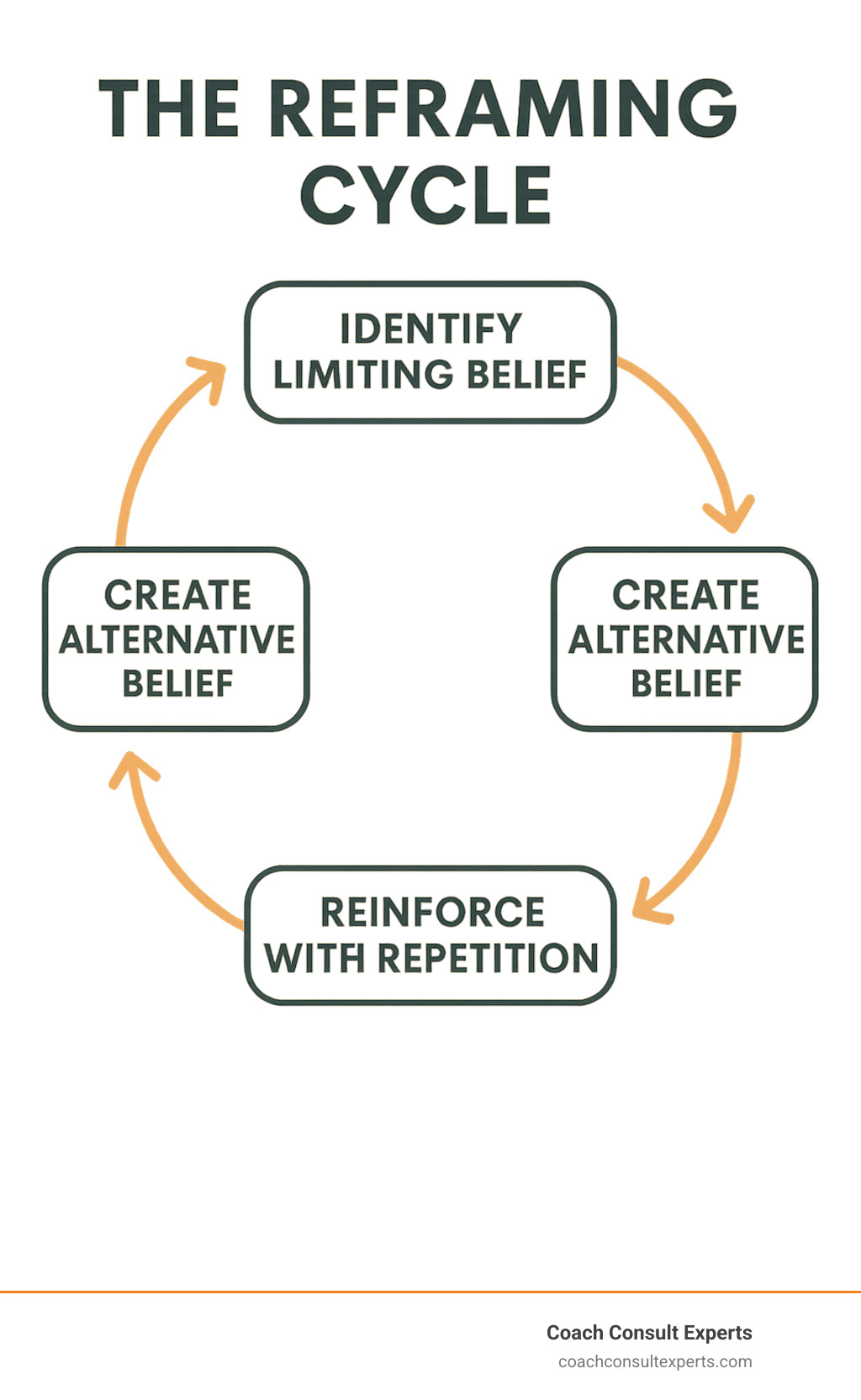
Research on self-compassion shows that treating yourself kindly when you slip speeds progress far more than self-criticism. Pair that insight with a growth mindset and you have the core recipe for lasting change.
| Fixed Mindset Beliefs | Growth Mindset Alternatives |
|---|---|
| “I’m not good at this” | “I’m not good at this yet” |
| “I failed” | “I learned what doesn’t work” |
| “This is too hard” | “This will help me grow” |
| “I can’t do math” | “I can improve my math skills” |
| “I’m not creative” | “I can develop my creativity” |
More info about Subconscious Change
Technique 1: Cognitive Reframing
Become a detective. Every time a limiting thought pops up, ask: What evidence actually supports this? What contradicts it? Keep an evidence log—a short list on your phone or in a notebook—so your brain can’t “forget” proof that you’re capable.
Technique 2: Affirmations & Self-Talk Reset
Skip generic mantras. Craft statements that respond to your specific inner critic. When the voice says, “You’re not qualified,” reply, “My experience and fresh perspective add value.” Repeat during everyday tasks (e.g., while washing dishes) so it embeds effortlessly.
Technique 3: Visualization & Imagery
Before a challenging task, spend five minutes seeing—and hearing, smelling, feeling—a best-case outcome. This Functional Imagery Training sends congruent success signals to the subconscious, nudging actions to match.
Techniques 4-7 (self-compassion breaks, “act as if” experiments, micro-goal testing, and peer modeling) build on the same principle: small, repeated moments of proof beat one-off pep talks every time.
Use whichever tools resonate most; consistency, not quantity, does the heavy lifting.
Daily Habits & Tools to Cement New Empowering Beliefs
Overcoming limiting beliefs isn’t something you do once and forget about – it’s like tending a garden that needs daily attention. The beautiful thing is, you don’t need hours of work each day. Small, consistent actions create the most powerful changes.
Think of it this way: every time you catch yourself in an old limiting thought and choose a different response, you’re literally rewiring your brain. Neuroscience shows us that these micro-habits – tiny actions done consistently – build new neural pathways stronger than any dramatic one-time effort ever could.

The secret sauce is making belief work feel natural, not like another chore on your endless to-do list. Start with just 15 minutes of daily practice – that’s less time than most people spend scrolling social media before getting out of bed.
Morning journaling becomes your daily reset button. Spend five minutes writing about one limiting belief you noticed the day before. Challenge it with evidence from your real life. Then reframe it into something that actually serves you. Finally, pick one small action you can take that day to test your new empowering belief.
Success tracking might sound boring, but it’s actually quite powerful. Keep a simple record of your daily wins, no matter how tiny they seem. Had a good conversation with a colleague? Write it down. This practice builds concrete evidence against those sneaky beliefs that whisper “nothing good ever happens to you.”
Here’s a technique that works surprisingly well: cue-based breathing. When you notice limiting thoughts creeping in, take three slow breaths and consciously shift to an empowering statement. This creates what psychologists call a “neural interrupt” – basically, you’re teaching your brain to pause instead of automatically spiraling into old patterns.
More info about Mindset Life Coach
Habit Stacking for Lasting Change
Your brain loves consistency, so why not use that to your advantage? Habit stacking means attaching new belief-changing practices to routines you already do without thinking.
After you pour your morning coffee, write down one empowering affirmation. After you check your email, spend two minutes reviewing evidence that contradicts your limiting beliefs. After you brush your teeth at night, visualize tomorrow’s success for just one minute.
These tiny actions might feel almost silly at first, but they’re doing something profound. Each time you complete one of these micro-practices, you’re telling yourself: “I’m someone who actively works on personal growth.” That identity shift is where the real magic happens.
Tech & Templates That Help
While apps and spreadsheets can’t do the inner work for you, the right tools can make your practice much easier to maintain. The key is finding simple systems you’ll actually use, not elaborate setups that become another source of overwhelm.
A basic belief-tracking sheet can be as simple as a notebook with columns for the date, what limiting belief you noticed, what triggered it, evidence against the belief, your reframed statement, and one action you took. Nothing fancy required – just consistent documentation of your progress.
From Solo Work to Collective Growth: Mentors, Coaches & Supportive Cultures
Working on your mindset in isolation only gets you so far. Studies on mentoring benefits show participants are promoted five times more often because outside eyes quickly expose blind spots you’ve accepted as “truth.”

I’ve seen this in our Coach Consult Experts groups: someone arrives convinced they’re “too old to pivot.” Minutes later they meet a peer who made the same leap last year—and the belief starts to crumble.
Build Your Personal Success Squad
- Accountability partner: trade weekly check-ins, flag each other’s limiting language.
- Peer feedback: ask, “What strengths do you see in me?” Fresh perspectives surface talents you ignore.
- Mentor or coach: fast-tracks change with custom exercises and honest challenge.
Fostering a Belief-Smart Workplace
Leaders can multiply this effect:
* Model vulnerability. Share your own mindset problems and fixes.
* Promote psychological safety. Teams who can admit confusion without fear naturally dismantle “I must be perfect” beliefs.
Collective support turns rewiring from a lonely chore into a shared trip.
Frequently Asked Questions about Limiting Beliefs
Let me address the questions I hear most often from clients who are just starting their journey of overcoming limiting beliefs. These concerns are completely normal – in fact, asking these questions shows you’re already taking the first step toward change.
What causes most limiting beliefs?
The roots of limiting beliefs usually trace back to a few key sources, and understanding them helps you realize that these beliefs aren’t your fault – they’re learned responses that made sense at the time.
Childhood experiences often plant the strongest seeds. Maybe a teacher said you weren’t “math material,” or a parent constantly worried about money, creating beliefs about scarcity. Your young brain tried to make sense of these experiences and created rules to keep you safe.
Societal conditioning also plays a huge role. Messages about what’s “realistic” for people from your background, gender, age, or circumstances can become internalized as personal limitations.
Past failures can create lasting mental patterns too. One rejection letter might become “I’m not good enough,” or a business setback might transform into “I’m not cut out for entrepreneurship.” Your brain generalizes from specific events to protect you from future disappointment.
The fascinating thing is that most limiting beliefs form when our minds make false connections between events and our worth or capabilities. Understanding this helps you see that these beliefs aren’t accurate assessments – they’re protective mechanisms that have outlived their usefulness.
How long does it take to replace a limiting belief?
This is probably the question I’m asked most, and I understand why. When you’re feeling stuck, you want to know when relief will come. The honest answer is that it varies significantly based on several factors.
Some people experience dramatic shifts within weeks when they consistently apply the techniques we’ve discussed. I’ve seen clients have breakthrough moments where a belief that held them back for decades suddenly loses its power. The brain’s neuroplasticity means change can happen faster than you might expect.
However, most lasting change takes 3-6 months of consistent daily practice. You’re not just changing a thought – you’re rewiring neural pathways that may have been strengthened for years through repetition.
Consistency matters more than intensity here. Daily five-minute practices will create more lasting change than sporadic hour-long sessions. The key is building new mental habits that become as automatic as the old limiting ones.
What if my belief feels too ingrained to change?
Here’s something that might surprise you: this feeling itself is often a limiting belief about limiting beliefs! I know that sounds like coaching-speak, but hear me out.
When a belief feels impossibly entrenched, it usually means it’s connected to core issues of safety, worth, or belonging. Your brain has categorized this belief as essential for survival, so it resists change even when the belief is clearly limiting your life.
The research on neuroplasticity is incredibly encouraging here. Your brain remains capable of change throughout your entire life. Even beliefs that feel fundamental to who you are can be transformed with the right approach and support.
Start with smaller, less threatening beliefs to build confidence in your ability to change. Maybe work on “I’m not good with technology” before tackling “I don’t deserve success.” Each small victory proves to your brain that change is possible.
When beliefs feel deeply entrenched, working with a qualified coach can provide the support and expertise needed for deeper change. At Coach Consult Experts, our rapid subconscious change programs are specifically designed to help with these stubborn patterns that feel impossible to shift alone.
Conclusion
Limiting beliefs are stories repeated so often they sound like facts. Thanks to neuroplasticity, those stories can be edited at any stage of life. Daily practice, plus the right support, lets you write a new script—one where opportunities feel exciting instead of off-limits.
If you’re ready for rapid, research-backed change, our VIP and group programs at Coach Consult Experts are built to rewire subconscious blocks quickly and sustainably. You don’t have to do this alone—and you’re certainly not stuck.
Start replacing “I can’t” with “I’m learning to” today; your future self is already thanking you.